
Book Review: Chess Strategy for Club Players by Herman Grooten
⭐️⭐️⭐️⭐️ Extremely competent, slightly dry guide to strategic chess most club players should consider picking up.

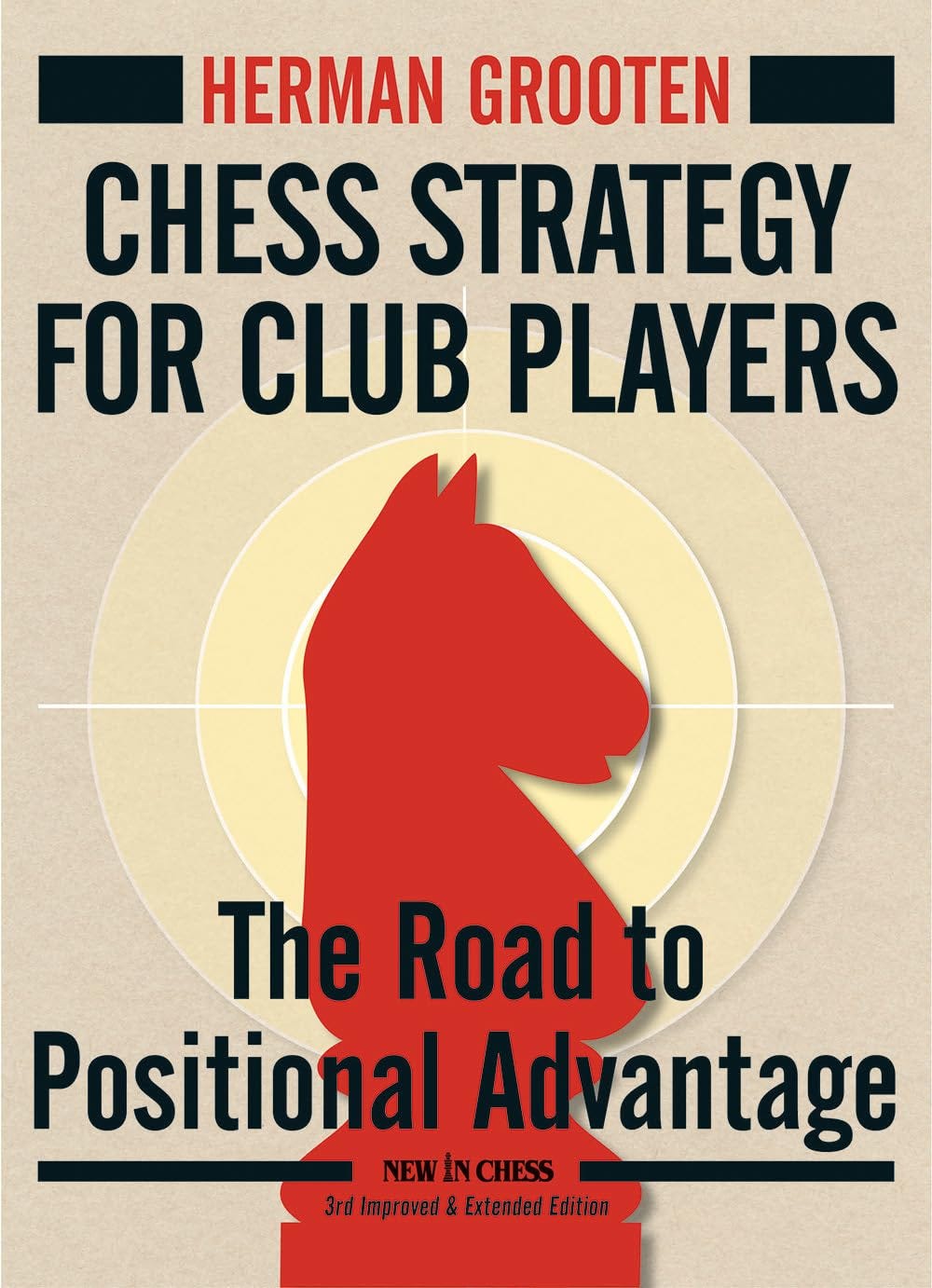
What is chess strategy anyway? Herman Grooten seeks to explain using the so-called “Table of Elements” attributed to Steinitz by Lasker. Grooten also heavily employs Nimzowitsch in the latter half of the book to explain certain concepts (such as the open file, control of the 7th rank, etc). The sum total here is a 26-chapter tome (including some tests, solutions to problems, and an epilogue) that acts as a positional sampler for the higher things in chess.
As far as what Steinitz’s (Lasker’s?) table of elements are, Grooten lays these out as follows:
Permanent advantages
Material advantage
Bad king position
Passed pawns in the middlegame.
Weak pawns for the opponent
Strong and weak squares
Pawn islands
Strong pawn center
Control of a diagonal
Control of a file
Bishop Pair
Control of a rank
Temporary advantages:
Bad piece posiiton
Inharmoniously placed pieces
Advantage in development
Concentration of pieces in the center (centralization)
Space advantage
Once offered, Grooten does his best to explain these by example after example and more-or-less succeeds.
Overall Grooten doesn’t present anything groundbreakingly new here, and I think that’s one of the book’s strengths. He simply organizes and shows the classical ideas with a lot of examples. Much like game collections based on teaching strategy (such as Michael Stean’s Simple Chess), the more mis-matched players provide the clearest examples, and these mismatches occurred more often back then, in the 19th and 20th century, than today. Therefore, Chess Strategy for Club Players relies on the faithful classics, but this does not stop Grooten from choosing positions his students, friends, and colleagues played, when they fit the bill properly. One historical quirk of this book is that even in its 3rd edition it precedes AlphaZero and the unleashing of neural networks on the royal game by a couple years, and therefore Grooten found some games against new-at-the-time computer chess engines to be relevant examples for teaching strategic and positional concepts (with the machines on the losing end of these bouts). This is more a testament to just how incredible machine learning has gotten when it comes to our understanding of chess than a mark against the book.
Grooten’s explanations benefit from his experience as a teacher and a coach, and I find that he is easy to understand, if a bit dry in his presentation, though sometimes Grooten’s wit peaks through. Analysis does not go extremely deep, but sufficiently enough to explain through some key variations. Everything is organized in a sensible manner such that the reader probably won’t feel lost as new ideas and plans are built on top of earlier-presented ones. One great improvement over especially older strategy books is that Grooten doesn’t employ the typically opaque prose in describing the features of a position or effect of a piece. Despite drawing liberally upon Nimzowitsch’s ideas, he never obfuscates the meaning through philosophical meandering. One small thing I have noticed is that Grooten often follows the established narrative of how chess strategy came to arise, and how the history of it should be taught. Students keen on history should still look at the “romantics” for developing strategy, because these waters run deeper than first meet the eye, but Grooten doesn’t delve very far into this era, sticking with Steinitz and those who followed him.
Overall this is one of those books that slots nicely in the intermediate to advanced level of chess player skill, and should be considered once a player reaches a rating of 1500-1600 over the board. It’s not a one-stop-shop to fix everything, but rather a broad sampling of different strategic and positional ideas to improve one’s game beyond brute-force tactics. The book is worth multiple reads and revisits (I’ve gone through it at least three times in the last six years), as long as the student is able and willing to play lots of longer games to learn how to apply the methods and ideas contained within. However, it’s not one-size-fits-all nor do I think it is perfect in its presentation. I have both the book and Chessable version, and in my opinion, the book version is better if you’re more interested in reading. The Chessable version, though outdated by Chessable’s own standards for courses today, is better if you’re more interested in practicing, though not every trainable is made equal. Overall I enjoy the book more than the course.


I don't think you actually mean "dearth of examples" there?
Just ordered it…