
Book Review: Paul Morphy, by Geza Maroczy
⭐️⭐️⭐️⭐️ Quantity is quality, as Russell Enterprises brings an early-20th century chess classic in to the 2020s with a first-time English translation and hundreds of Morphy games.

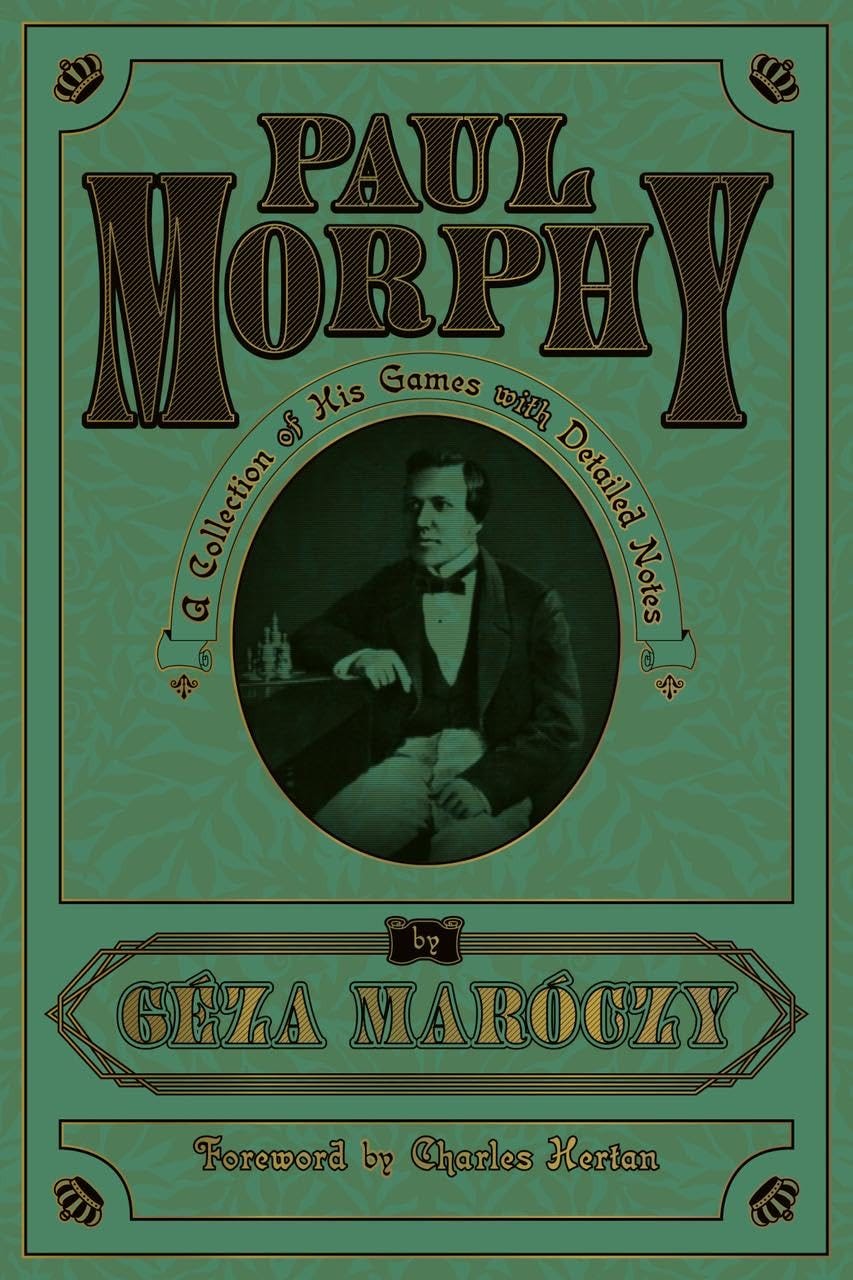
Thanks to Russell Enterprises for the review copy.
Paul Morphy: A Collection of His Games with Detailed Notes, released in 1908 in German and translated to English by Robert Sherwood, is a wonderful collection of Morphy’s games, lightly annotated by Maroczy, whose analysis remains unmolested by any modern update or corrections (Charles Hertan’s foreword urges us not to “discard the baby with the bathwater” even if we turn on Stockfish for a cold assessment).
The book features over 400 games by Morphy, including some labeled “of doubtful authenticity” and a small feature on some of Morphy’s endgames by Karsten Muller. Given that the paperback runs just over 350 pages, it’s appropriate to say Maroczy’s Paul Morphy is packed with games, and it’s shocking the number of odds games Morphy played in casual settings, and how fortuitously and anonymously (really, who wrote all these games down??) they were recorded for Caissaic posterity.
Maroczy’s analytical work is gigantic when considering that he gives notes to almost every game featured in the book, though they are rather lightly annotated — to Maroczy’s credit. On occasion Maroczy goes into a long variation, and many a time the silicon nannies will demur on Morphy’s (and his annotator Maroczy’s) ideas, but that doesn’t stop the games from being full of teachable insights and inspiring moments. Also nice is that the book acts as a sparse biography of sorts, playing things out in reasonable chronological order as Morphy goes from home in New Orleans to New York, eventually to Europe, back home, and back to Europe again, etc. It’s a slight catch of breath as we’re given the historical details before being thrust into gobs of Morphy games again and again.
Because the reader doesn’t ever get bogged down in long variation after long variation, it’s relatively easy to play through many games in a short amount of time. Conversely, as far as the annotations are concerned, Maroczy’s tight-lipped commentary leaves some room to be desired for lower-level players looking for move-by-move instruction. Any player who is ready to study Morphy on their own should pick it up, but I would hesitate to recommend this book for a rank beginner, because so much of chess strategy and positional thinking is taken for granted by its author. Nevertheless, I do think there has to be some benefit from the sheer volume of games by Morphy here, and the quantity of them is one of the book’s greatest qualities. Simply playing through the games and letting your mind wander the board can’t be bad especially when you’re looking for a dash of inspiration with Morphy’s romantically positional style of play.
Russell Enterprises should also be commended for continuing their important work of bringing old classic books back to the modern player, especially when they make the deliberate choice to leave the analysis untouched(!); and in this case they also had to translate it for the first time for an English-reading audience. Chess history buffs probably already took note, but if you’re looking for a Morphy game collection, this one is very meaty.
At first I mistook "...with a first-time English translation..." to mean it was newly translated for this wonderful Russell Enterprises edition. I'm pretty sure it was not, since there is a Caissa Editions of this book - without, of course, the new Forward by Charles Hertan and the Endgames section by Karsten Müller - that was published in 2012.
Nick, thank you for this excellent review! Russell Enterprises does a fantastic job with their high-quality publishing of both new books and old classics.