
Book Review: Chessagram Vol. 1
⭐️⭐️⭐️½ A short workbook for beginners that focuses on tactical move orders.

Thank you to Jared @ Tall Pawn Productions for the review copies.
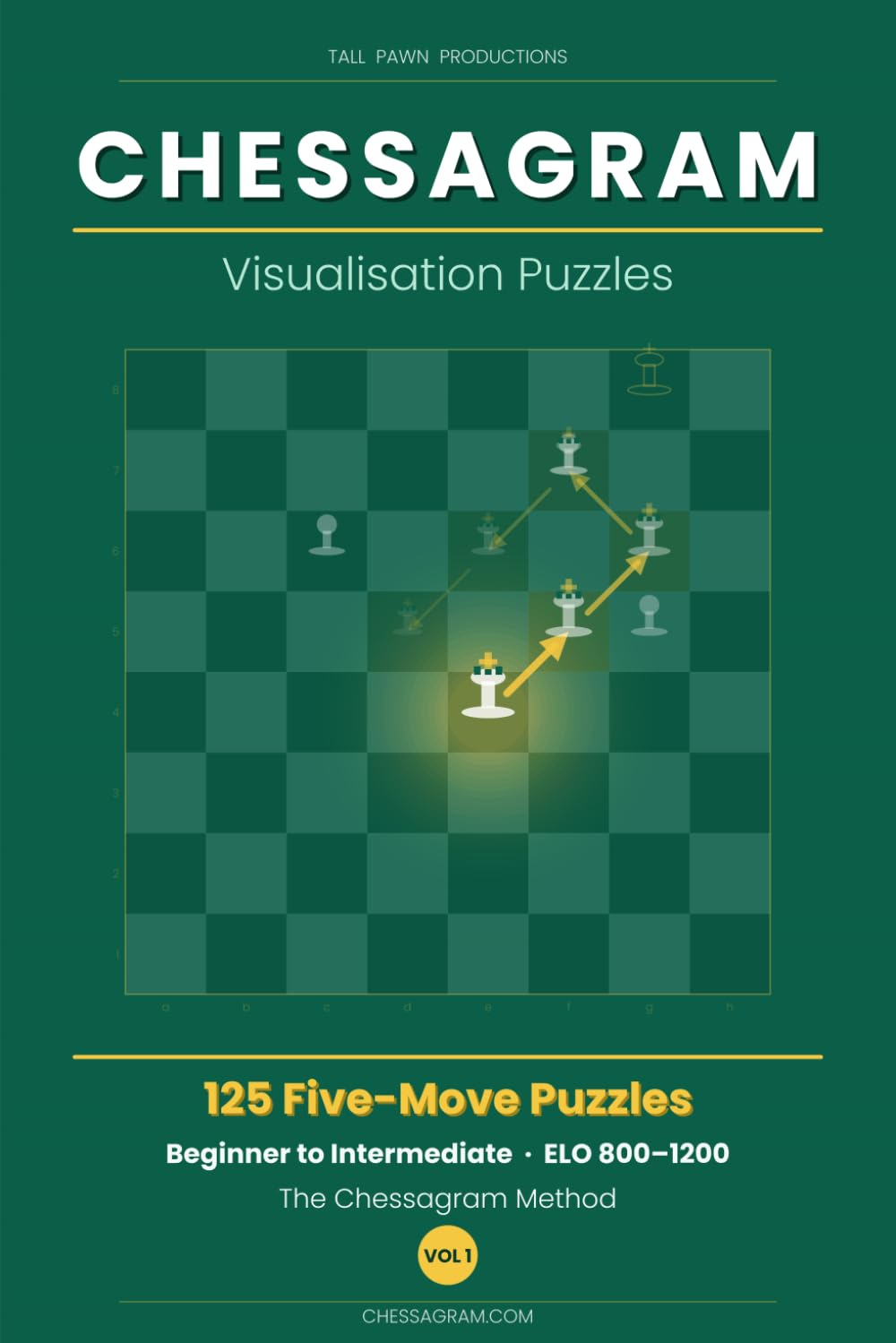
Chessagram, Vol. 1, brings a novel approach to the chess puzzle book formula: Give the student the moves, but out of order. Their task is to find the correct sequence of moves.
Move order sequences in tactical situations are one of the most common things even grandmasters get wrong, and so it makes sense to look at each candidate move in turn, turn the sequences in your head until you find the best continuation, and then execute on it. This is a skill that players grow in time, but it’s one aspect of tactics that I think must be deliberately practiced in order to really improve.
Vol. 1 sources its puzzles from Lichess; I suspect the ratings also come from Lichess. I can safely say this is a book squarely for beginners. If you can solve 800-1200 level puzzles on Lichess on the fly, you’re likely too strong for this book and should look for future volumes instead. If you’re a teacher, this might be a decent pick-up for your beginner-level students.
What I like about the book is its simplicity: 1 puzzle per page, sorted from 800 to 1200 rating. The top half of each page is the puzzle; the bottom half has the moves and then five bubbles where the player can write them down in the correct order. White always moves first. Solutions are in the back. It’s a nicely-sized workbook, and with only 125 puzzles in it, should not overstay its welcome regardless.
While it seems strange to give someone the answers to a position right away, I’m not convinced it’s such a bad idea. This book may serve as a good introduction to the beginner on how to figure out the move order. My suggestion for readers:
Use an index card to cover the moves, and try to solve the puzzle on your own. Once you’ve figured out your moves, you can look at the moves and probably see that you got the order correctly.
If you’re having a hard time with the puzzle, look at the moves in the answer. Which moves did you miss? Which moves did you want to play, but you got them out of order?
Note: Jared (the publisher) reached out to me and gave more instructional information which was not included in my review copy but apparently will be included in new prints of the book. He refers to this as the “Chessagram Method”, and is pretty similar to the above suggestions I gave. It is, as follows:
1. Pick a book whose lower rating band is ~200+ above your current Lichess puzzle rating — deliberately beyond your normal solving ability (Zone of Proximal Development)
2. Calculate the full five- or seven-move sequence in your head from the position alone — no moves, no hints. The struggle primes the brain (Active Learning)
3. Reveal the Move Bank when your thinking stops producing new information — not on a timer, but when another minute of staring wouldn’t teach you anything new. The five/seven correct moves appear in scrambled order: confirmation if you saw the line, reverse-engineering scaffold if you didn’t.
4. If still stuck, peek at the Answers one move at a time — each peek a minimum dose. Return to the position after each and visualise the rest yourself.
5. Success isn’t “I solved it” — it’s “I found the gap.” A cold solve means no gap was exposed. Any other outcome means you located a specific weakness(es) — which is exactly what training is for.
Thanks to Jared for providing this information.
I think this is the best way to get the most help out of the book; having the moves to fall back on is a nice touch. But ultimately study the book the way you find the most enjoyable.
One critique I have, though this may not even be applicable given the skill range of player this book is targeted toward, is that for many of the puzzles, after one finds the first and or second move for White, Black’s moves are virtually superfluous and don’t matter anymore — the win is obvious for White. In an online tactics trainer (such as on Lichess) this is not a problem because the trainer will make the opponent’s moves for you. But if you’re trying to solve positions without looking at the moves first, you’ll probably find that even on White’s second move, Black is completely lost; so some of these five-ply puzzles are essentially three-ply; Black’s follow-up is usually the best of a bunch of bad options. Because of this, I feel like these puzzles may have been chosen at somewhat random rather than for their instructive value; the method is more interesting than the puzzles.
Secondly, though it can be a frustrating experience for new players, I think that being able to solve a position in which Black is to move and win, and to do so from the perspective of White, is actually very good visualization practice. If this book had some positions where Black was to play and win, I think it would be strictly better in the long run. However, it suits the nature of a first volume to be beginner oriented, so I understand if this was not the priority for this. For future volumes, I think this would be an important next step.
Chessagram Vol. 1 is trying to do something a little different. The execution is a little uneven, and I think that the puzzles could use the deft hand of a chess coach’s curation, but it at least shows some promise. In my opinion, one’s mileage with the Chessagram Method will vary, but it’s worth a try if you’re looking for a more guided puzzling experience that may also teach you the important tactical skill of switching up move orders.
A well done review . Looks like an interesting method of calculation