

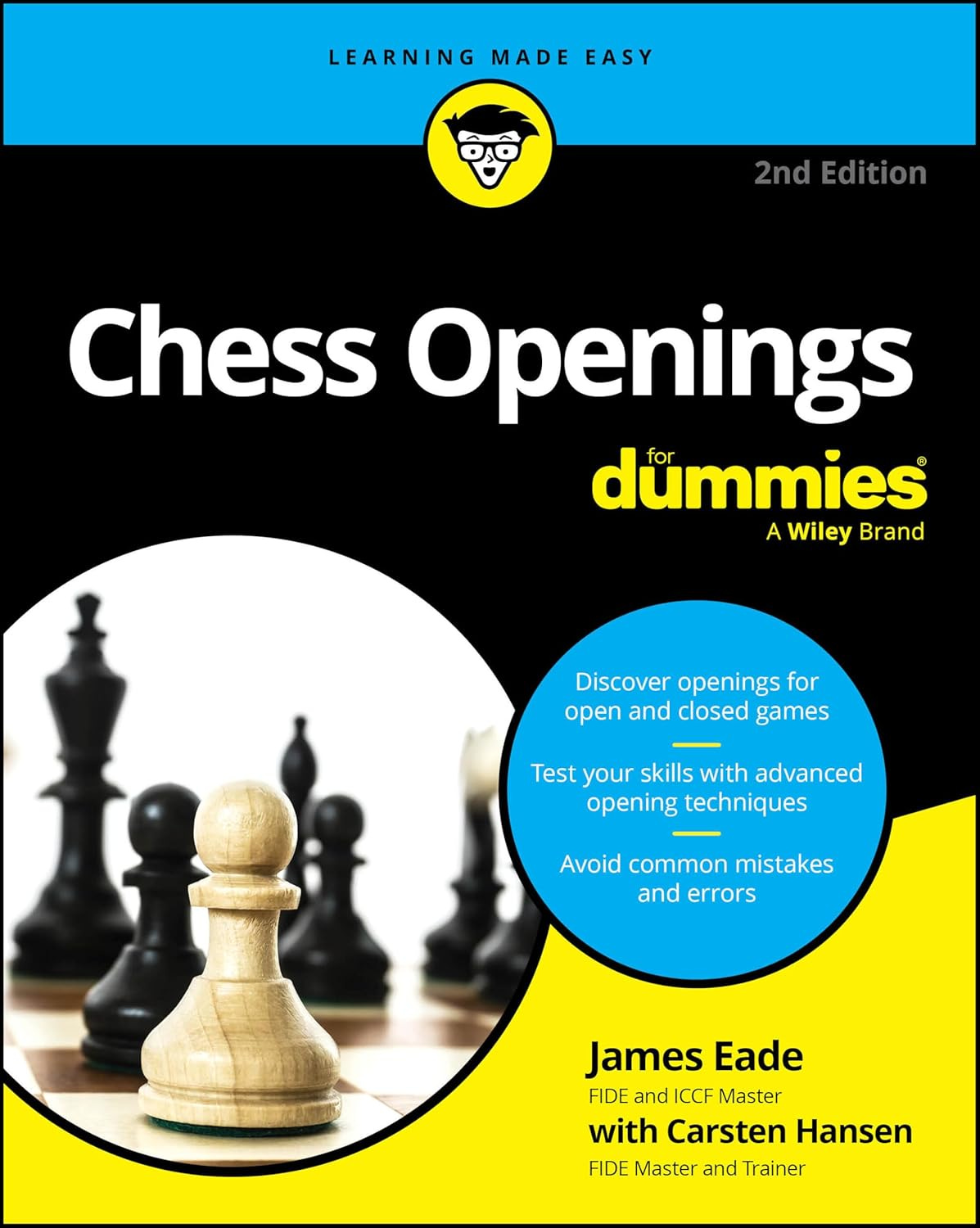
Chess Openings for Dummies, by James Eade, with Carsten Hansen, gets a second edition 15 years after the original came out. What can change in 15 years? Chess theory-wise, a whole lot. For one, the open source and free Stockfish exists; and neural-network engines have forever changed the way we evaluate and play chess positions. For two, so has the market for chess opening books, because of both free resources online and paid courses on platforms like Chessable, Chessly, Chessbook, and some other chess-thing. Sometimes, it seems chess opening books might go the way of the dinosaur, but perhaps a shift in the consumer mindset that is inching back towards physical (actual, real) ownership is pushing chess opening books back to the forefront. The tactility of a real book is unmatched.
In any case, the second edition of Chess Openings for Dummies comes at an interesting time where the market is saturated with online resources for opening repertoires. It also has an interesting premise.
The authors are quick to point out that any given starting variation could be, and often has been the entire subject of whole books, so it’s not only foolhardy but also practically impossible to create a universal resource for every single opening line. Instead, Chess Openings for Dummies acts as a sort of guidebook for what openings the reader might consider studying for themselves more deeply. Find an opening you might be interested in and check it out— the book doesn’t expect you to go through it front to cover.
After a bit of chess strategy advice (another subject on which much ink has been spilled), they content themselves with a quick look at the major openings: An explanation of each line, why one might choose it for their own repertoire (“If you’re looking for relatively easy development and are willing to defer a direct confrontation for a while, the Classical Variation [of the Caro-Kann] may be for you.”), and typically two example games, one where things go great for White, and one where they go great for Black. Notably, most of these games are recent examples from master play — the authors appear to have gone out of their way to avoid classical historical examples of how these openings were played.
This also means that for virtually all intents and purposes, the historical assessments of the openings are completely left out of the book, because for this purpose, it’s virtually irrelevant. I find this approach double-edged; you’re not going to see the main idea from which the opening was originally born, but at the very least it helps not to retread old ground, which is the usual course for so many opening resources. On the positive side, by-and-large, none of the selected games are slogs. Things end somewhere closer to the middlegame than the endgame — they try to keep the reader on track by focusing on the immediate results of the opening.
Most games are dedicated three or so pages, with some light analysis when deemed suitable to the purpose of explaining the opening. This makes the book accessible to any reader who has a chess board and wants to play through the game. I do wish there were more printed diagrams. Some games are given only a single diagram. With this book and its target audience, there should be many more diagrams.
The selection of opening lines is very good, even when it comes to the trickier and less-common tries. Sidelines and gambits aren’t ignored, and you’ll even see stuff like Bird’s Opening (1.f4!?) make an appearance. Since they’re not trying to provide a repertoire, one shouldn’t expect thorough coverage of the opening in the analysis. Rather, it’s a sampler: Play through the games. When you see a line you like, that’s a sign that you should research deeper with other resources. That’s the idea behind Chess Openings for Dummies. It helps point you where to go next. The final chapters detail the common pitfalls in the openings and some additional chess-improvement advice, including where to go next. The book seems well aware of its supplemental nature and this is to its credit.
With this book there is some good and some room for improvement. I like the premise. It’s a deeper version of what Jeremy Silman did with the openings in his Complete Book of Chess Strategy. It’s tailored, at least in the premise, towards the novice. However, I think depending on one’s level, the sample games might not be the best representation of how their games are likely to go, even if they represent a modern treatment of the opening. The general advice is good, though I wouldn’t take every recommendation about choosing lines at face-value without also trying it for yourself (I’m sure the authors agree). Overall, however, it’s a decent choice for someone looking for a beginner-level reference to all opening lines. If you’re a big fan of the “For Dummies” brand, that should make choosing this book a bit easier, as it seems like another solid entry in that huge corpus.